

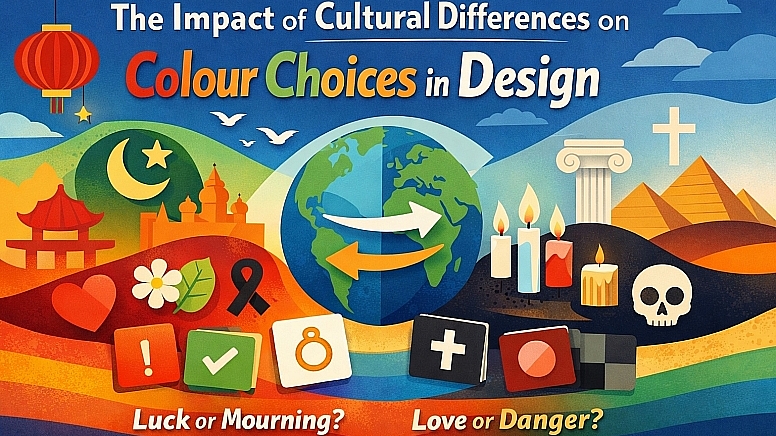
The Impact of Cultural Differences on Colour Choices in Design
Colour is not a universal language. Its meaning and emotional impact are constructed by culture, history, religion, and geography. For designers and brands operating in a global context, ignoring this reality is a direct path to misinterpretation, brand damage, and commercial failure.
Effective international design requires moving beyond personal or local colour associations to a strategy of intentional, context-specific colour application that either adapts to local meanings or builds a transcendent brand meaning that supersedes them.
- Core Premise: Colour symbolism is culturally relative, not absolute.
- Primary Risk: A colour that signals trust in one market may signify mourning or danger in another.
- Strategic Imperative: Design and colour choices must be informed by cultural due diligence, not aesthetic instinct alone.
- Optimal Outcome: A colour system that is either locally resonant or globally distinctive through consistent branded use.
Colour as a Cultural Construct, Not a Biological Absolute
While some colour responses have biological roots (e.g., red's ability to increase heart rate), the vast majority of colour meaning is learned. These associations are embedded through millennia of art, literature, religious practice, political history, and natural environment. A designer's default interpretation of colour is, therefore, a product of their own cultural conditioning.
The commercial and communicative stakes are high. Using white, the colour of weddings and purity in many Western cultures, for a product launch in several East Asian markets could associate the brand with funerals and loss. Launching a financial app with a green "success" motif may falter in parts of Southeast Asia where green can be associated with sickness or infidelity.
These are not superficial missteps; they create subconscious barriers to trust and adoption. Conversely, deep cultural research can reveal powerful opportunities. A brand using red strategically in China can tap into associations with luck, prosperity, and celebration far more potent than in the West. The impact of culturally intelligent colour choice is measured in brand relevance, user comprehension, and ultimately, market acceptance.
Deconstructing the Variables of Cultural Colour Meaning
Understanding this impact requires analyzing the specific cultural forces that assign meaning to hue.
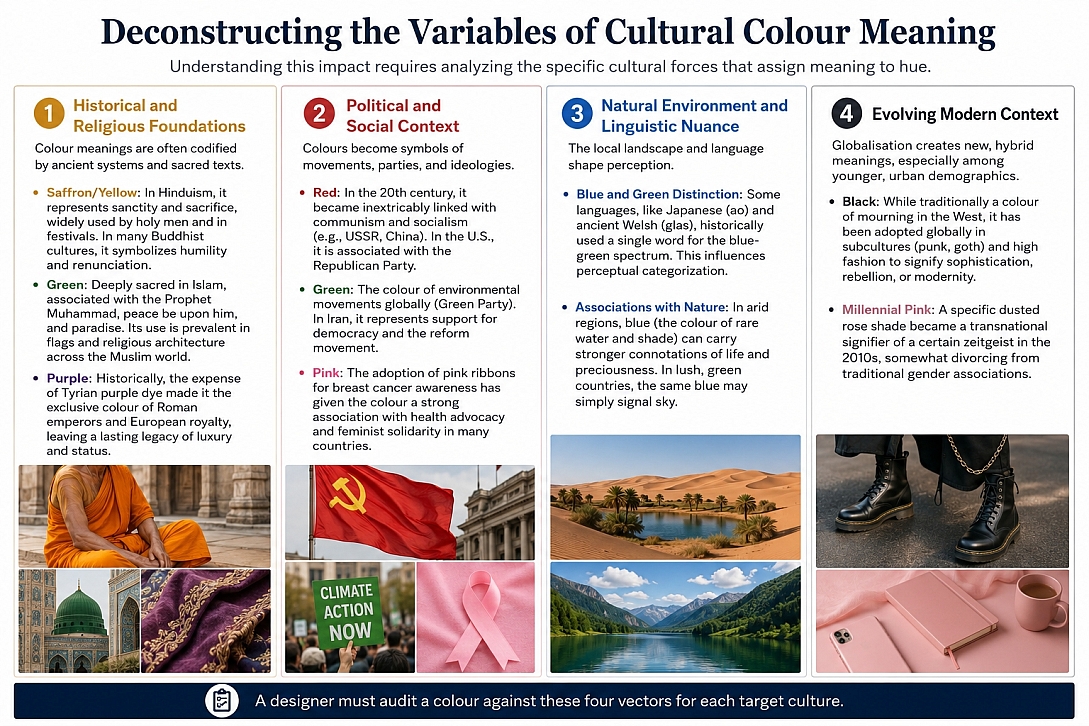
1. Historical and Religious Foundations: Colour meanings are often codified by ancient systems and sacred texts.
- Saffron/Yellow: In Hinduism, it represents sanctity and sacrifice, widely used by holy men and in festivals. In many Buddhist cultures, it symbolizes humility and renunciation.
- Green: Deeply sacred in Islam, associated with the Prophet Muhammad, peace be upon him, and paradise. Its use is prevalent in flags and religious architecture across the Muslim world.
- Purple: Historically, the expense of Tyrian purple dye made it the exclusive colour of Roman emperors and European royalty, leaving a lasting legacy of luxury and status.
2. Political and Social Context: Colours become symbols of movements, parties, and ideologies.
- Red: In the 20th century, it became inextricably linked with communism and socialism (e.g., USSR, China). In the U.S., it is associated with the Republican Party.
- Green: The colour of environmental movements globally (Green Party). In Iran, it represents support for democracy and the reform movement.
- Pink: The adoption of pink ribbons for breast cancer awareness has given the colour a strong association with health advocacy and feminist solidarity in many countries.
3. Natural Environment and Linguistic Nuance: The local landscape and language shape perception.
- Blue and Green Distinction: Some languages, like Japanese (ao) and ancient Welsh (glas), historically used a single word for the blue-green spectrum. This influences perceptual categorization.
- Associations with Nature: In arid regions, blue (the colour of rare water and shade) can carry stronger connotations of life and preciousness. In lush, green countries, the same blue may simply signal sky.
4. Evolving Modern Context Globalisation creates new, hybrid meanings, especially among younger, urban demographics.
- Black: While traditionally a colour of mourning in the West, it has been adopted globally in subcultures (punk, goth) and high fashion to signify sophistication, rebellion, or modernity.
- Millennial Pink: A specific dusted rose shade became a transnational signifier of a certain zeitgeist in the 2010s, somewhat divorcing from traditional gender associations.
A designer must audit a colour against these four vectors for each target culture.
Five Contexts for Culturally Informed Colour Design
1. Global Brand Launch with Localized Marketing Campaigns
- Constraints: Must maintain core brand recognition while allowing marketing materials to resonate in disparate markets.
- Common Mistakes: Using a single global campaign asset with culturally problematic colour symbolism. Forcing a localized meaning (e.g., "green means go") where it does not exist.
- Practical Advice: Lock the core brand identity colours (logo, product) as non-negotiable. Develop a flexible secondary and accent palette for marketing that can be swapped regionally. For a campaign themed "New Beginnings," use white and gold in Western markets (purity, celebration), but switch to red and gold in Chinese markets (luck, prosperity) for digital ads, packaging sleeves, and point-of-sale materials, while the product itself remains unchanged.
2. E-commerce Website Internationalization
- Constraints: Must facilitate trust and clear transaction pathways across cultures, often within a single, global codebase.
- Common Mistakes: Using colour alone to indicate category, sale status, or interactive states. Employing festive colours (like red/green) for a "holiday sale" is not globally relevant.
- Practical Advice: Use colour as a secondary, not primary, cue. Pair a red "Sale" badge with the text "SALE" and a distinctive icon. For key CTAs like "Add to Cart" or "Buy Now," use the brand's primary action colour globally, but ensure its function is reinforced by shape, placement, and clear copy. Avoid using culturally loaded colours (like green for "positive") as the sole indicator of system status.
3. Packaging Design for Export Markets
- Constraints: Must appeal on crowded shelves, communicate product essence, and avoid negative associations, often with limited space for multiple versions.
- Common Mistakes: Imagery or colour schemes that are appealing domestically but odd or off-putting abroad (e.g., using black extensively on a food product in markets where black is not associated with food).
- Practical Advice: Conduct a full colour symbolism audit for each primary export market. For a health supplement brand, using white packaging (purity, science) may work in Europe, but in parts of Asia, it may need to be paired with gold (value, potency) or green (natural, wellness) to achieve the same positioning. Consider creating two or three master packaging designs for major cultural blocs (e.g., Western, East Asian, Middle Eastern) rather than dozens of country-specific variants.
4. UI/UX for a Fintech or Health App
- Constraints: Must convey complex, sensitive information (financial data, health status) with absolute clarity and foster trust.
- Common Mistakes: Using red exclusively for "debt" or "low balance" in a market where red is auspicious. Using a green progress bar in a region where green has negative health connotations.
- Practical Advice: For critical data visualization, do not rely on a red/yellow/green "traffic light" system. Use a monochrome scheme with varying saturation or pair colour with unmistakable icons (⬤ ● ○) and clear text labels ("Good," "Fair," "Check"). For trust signals, research local associations: blue may signal trust in one market, but in another, a deep blue-green or even a specific shade of brown might be more associated with stability and reliability.
5. International Event Branding and Environmental Design
- Constraints: Must create an inclusive, welcoming atmosphere for a diverse international audience at a conference, expo, or Olympic Games.
- Common Mistakes: Choosing a theme colour that has a strong negative political or religious connotation for a significant attendee group. Using national colours in a way that could be seen as appropriative or insensitive.
- Practical Advice: Opt for a palette of "safe" international colours, often blues, teals, and earth tones, that have fewer extreme negative connotations. Use colour primarily for wayfinding and energy, not heavy symbolic meaning. Incorporate colour through light and texture rather than large symbolic graphics. When in doubt, use the host country's cultural colours subtly in patterns or accents, not as dominant branding elements.
A Comparative Analysis of Colour Symbolism Across Cultures
| Colour | Common Western Association | Association in China | Association in the Middle East (Islamic Context) | Association in India |
|---|---|---|---|---|
| Red | Danger, Love, Stop | Luck, Joy, Prosperity, Celebration | Caution, Death (contextual) | Purity, Fertility, Marriage, the Sacred |
| White | Purity, Peace, Weddings | Mourning, Death, Humility | Mourning, Purity | Mourning, Peace, Unhappiness (in some contexts) |
| Green | Nature, Go, Environment, Jealousy | Infidelity, Exorcism (in some folklore) | Islam, Paradise, Hope, Safety | Nature, Fertility, New Beginnings, the Muslim community |
| Black | Mourning, Death, Sophistication, Power | Stability, Honesty | Mourning, Mystery, Rebirth | Evil, Negativity, Darkness |
| Yellow | Caution, Happiness, Cowardice | Royalty, Power (historically) | Happiness, Prosperity, Mourning (Egypt) | Sacred, Auspicious, Knowledge, Merchant Class |
Advanced Nuances: Nuance, Saturation, and Pattern
For experts, the conversation moves beyond basic hue to subtler dimensions.

The Role of Saturation and Tone: A bright, saturated red may scream "sale" in the U.S. but signify celebration in China. A muted, dusty rose may read as sophisticated globally. The specific shade of a colour carries its own meaning. "British Racing Green" and lime green are both green but communicate entirely different concepts.
Pattern and Combination: Colours are rarely seen in isolation. The meaning can change in combination:
- Red & Gold: Prosperity and luxury (China).
- Green, White, & Red: National colours of Italy, Mexico, Iran, and Hungary—use requires extreme care.
- Saffron, White, & Green: The Indian flag, evoking immediate national pride.
Building a Transcultural Brand Colour: Some global brands successfully dissociate their primary colour from local symbolism through relentless consistency. Tiffany & Co.'s robin's egg blue is not about cultural meaning; its meaning is "Tiffany." This requires decades of investment and monolithic branding. For most, a strategy of glocalisation—a stable core with adaptable peripherals—is more effective.
Common Pitfalls and Misconceptions
Misconception: "There are universal colours for emotions like trust or excitement." This is a dangerous oversimplification. While excitement may be elicited by high saturation, the hue that carries it could be red, orange, or even electric blue, depending on context. Trust is even more culturally variable, linked to blues in some cultures, greens in others, and specific deep neutrals in yet others.
Pitfall: Relying on superficial online "colour meaning" charts. Many simplistic infographics present a single meaning per colour per country, missing nuance, regional variation, class differences, and modern evolution. They are a starting point for inquiry, not a reliable source for decision-making.
Misconception: That adaptation is always necessary. For purely functional, utilitarian products (e.g., a power drill, industrial software), cultural colour adaptation may be minimal. The colour strategy should focus on contrast, visibility, and universally understood safety cues (like red for emergency stops). The need for adaptation scales with the product's emotional, social, or symbolic weight.
Pitfall: Forgetting about diaspora and multicultural audiences. A design for a multicultural city like London, Toronto, or Sydney must consider a mosaic of interpretations simultaneously. The solution often lies in clarity, accessibility, and avoiding the most strongly negative singular interpretations rather than trying to please all.
A Method for Culturally Informed Colour Strategy
- Define the Communication Goal. What must the colour do? (Evoke trust, signal innovation, denote safety, encourage purchase?)
- Map the Target Cultural Contexts. List primary and secondary markets. Identify key cultural vectors: dominant religion, major historical events, political landscape, and language nuances.
- Conduct a Colour Symbolism Audit. For each key colour in your palette, research its meanings in each target context. Use academic sources, local marketing experts, and field research; not just web searches. Create a "Risk/Opportunity" matrix.
- Develop Strategic Options:
- Adaptation: Create region-specific palettes that align with local meanings.
- Transcendence: Use colour so consistently and distinctively that it becomes synonymous with your brand alone (high investment).
- Neutralization: Use a culturally "safe" palette of low-saturation, natural, or metallic tones, letting imagery and copy carry cultural meaning.
- Prototype and Test with Native Audiences. Show mockups to focus groups or collaborators within the target culture. Ask not "Do you like this?" but "What does this colour make you think/feel?" and "What does this company seem to be?"
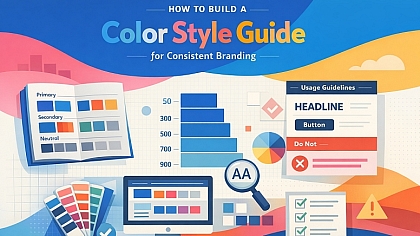
- Create a Culturally Keyed Style Guide. Document the final palette with clear usage rules for each region. Specify why choices were made to guide future designers.
- Implement and Review. Launch and monitor engagement metrics by region. Be prepared to iterate based on real-world reception.
Questions on Cultural Colour Differences
How do you handle a colour that is positive in one market but negative in another? You have three main choices:
1) Segment: Use different colours for different markets (e.g., different campaign accents).
2) Contextualize: Use the colour but surround it with imagery, patterns, and copy that reinforce the intended positive meaning in each market.
3) Avoid: If the negative association is severe (e.g., linked to tragedy), choose a different colour for the global palette.
Is a "global neutral" palette possible? Yes, but it is limited. Palettes built from nature (stone, sand, wood, leaf greens), the sky (gradients of blue), and sophisticated low-saturation tones (muted teals, dusty roses, warm grays) tend to travel better because they are less culturally coded. They convey mood and quality rather than specific symbolic messages.
How important are colour preferences versus colour meanings? Preferences (liking a colour) and meanings (what it signifies) are different. A person might like the colour black for its sophistication, but avoid it for a wedding invitation because of its cultural meaning of mourning. Design must address meaning first, as it governs appropriateness; preference influences appeal within appropriate bounds.
What about accessibility in a global context? Accessibility standards like WCAG are technical and should be followed universally. However, the cultural perception of what constitutes "good contrast" can vary. A stark black-on-white may be perfectly legible but feel harsh in some cultures, where a dark brown on cream achieves the same contrast ratio with a warmer, more comfortable perception.
LEAVE A COMMENT
Recent Posts







0.0415