

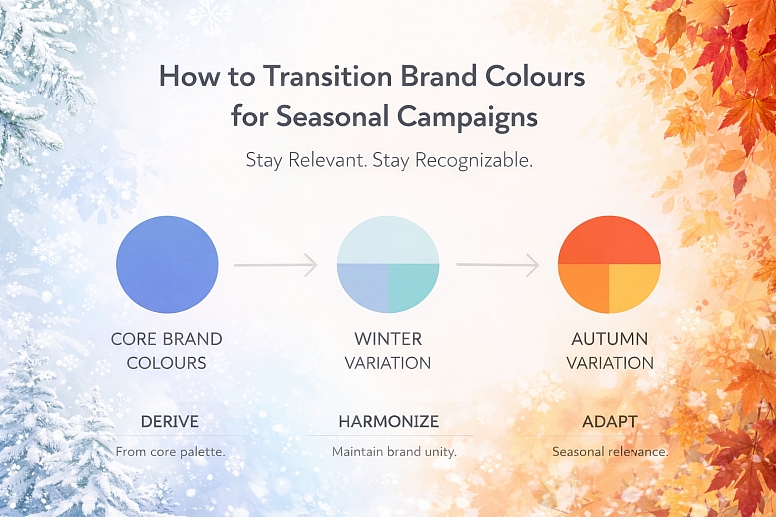
How to Transition Your Brand Colours for Seasonal Campaigns
Transitioning brand colours for seasonal campaigns is a strategic design operation, not a decorative exercise. The goal is to create timely, relevant consumer connections while maintaining immediate brand recognition.
This process involves systematic colour adaptation within strict guardrails, ensuring the brand's core identity remains intact while its expression becomes seasonally contextually appropriate. Done correctly, it refreshes perception and drives engagement without diluting brand equity.
- Primary Objective: Achieve seasonal relevance without sacrificing brand recognition.
- Core Constraint: All seasonal colours must be derived from or harmonize with the existing brand palette.
- Strategic Outcome: A coherent visual ecosystem where seasonal campaigns feel both fresh and unmistakably part of the brand.
- Key Process: Systematic colour shifting, not palette replacement.
The Strategic Imperative of Seasonal Colour Transitions
A brand's core colour palette is a primary asset, a visual shorthand built through consistent repetition. A drastic, arbitrary colour change for a campaign creates cognitive dissonance, forcing consumers to re-identify the brand, which erodes trust and recall. The strategic purpose of a seasonal transition is therefore twofold: to tap into the shared cultural and psychological cues of a season (warmth, festivity, renewal) and to frame the brand’s perennial offerings within a timely context.
The real-world impact is measurable. A cohesive seasonal colour system can increase campaign click-through rates by providing a fresh yet familiar visual hook. It improves cross-channel recognition, as the adapted palette creates a unified look across social media, email, web, and physical retail. Critically, it prevents brand fatigue by allowing for controlled variation within a recognizable framework, giving the brand a dynamic quality while its foundation remains stable. The transition is not about following trends, but about translating the brand’s enduring values into a seasonal language.
The Technical Framework for Colour Adaptation
A successful transition relies on a defined, repeatable technical methodology applied to the master brand palette.
1. The Foundational Brand Palette Audit: Every transition begins with a codified starting point. The master brand palette must be documented with precise values (HEX, CMYK, Pantone, RGB) and clear usage rules. This includes:
- Primary Brand Colour(s): The dominant, non-negotiable hue(s).
- Secondary Palette: Supporting colours.
- Neutral Base: Blacks, whites, grays, and brand beiges/tans.
- Accent/Interaction Colours: Used for CTAs and highlights.
This master palette provides the genetic material for all seasonal derivatives.
2. Seasonal Colour Derivation: Tinting, Shading, and Harmonizing: New seasonal colours are created by mathematically adjusting the master palette, not choosing unrelated hues. The primary methods are:
- Tinting with Seasonal Neutrals: Adding a warm cream to a brand blue creates a softer, autumnal sky blue. Adding a crisp, pure white creates a wintery, icy version.
- Shading for Depth: Adding black or a deep brown to a brand colour can create a richer, more grounded variant for fall or a dramatic accent for winter.
- Shift via Harmonious Analogues: Moving slightly around the colour wheel from a primary hue to an analogous colour (e.g., from a true red to a brick red-orange for fall) maintains harmony while shifting mood. This shift must be subtle—no more than 20-30 degrees on the wheel.
3. Establishing the Seasonal Ratio The 60-30-10 rule is recalibrated for the season:
- 60%: The Constant. The brand's core neutrals and backgrounds remain largely unchanged. This is the recognition anchor.
- 30%: The Seasonal Shift. The secondary brand colours are replaced or heavily influenced by their seasonal derivatives. This area carries the seasonal theme.
- 10%: The Accent Anchor. The primary brand colour often remains in its purest form, used sparingly for key CTAs or logos to guarantee brand fingerprinting.
4. Creating a Seasonal Sub-Palette Document: The output is a strict sub-palette. For example, "Q4 Holiday Palette":
- Core Neutrals: Brand White, Brand Charcoal (unchanged).
- Primary Seasonal: Brand Blue tinted with Winter White (
#E6F0F8vs. original#0066CC). - Secondary Seasonal: Brand Gray shaded with Dark Navy (
#2A3B4Dvs. original#7F8C9A). - Accent (Constant): Pure Brand Red (
#CC0000) for "Shop Now" buttons. This document forbids the use of non-derived colours.
Five Campaign Contexts for Seasonal Colour Transition
1. E-commerce Homepage and Product Collection Banners

- Constraints: Must drive immediate seasonal sales without confusing the core shopping experience or obscuring product colours.
- Common Mistakes: Overlaying strong seasonal colour filters on product photography, distorting true product colours. Using seasonal accents for primary navigation breaks year-round usability.
- Practical Advice: Keep the UI chrome (header, nav, footer) in the core brand palette. Apply the seasonal secondary colour only to campaign-specific banners and promotional modules. Use the seasonal tint as a background for "Holiday Gift Guide" headers, while keeping "Add to Cart" buttons in the constant brand accent colour. Ensure product images are shown on clean, neutral backgrounds without colour casts.
2. Social Media Asset Suite (Stories, Posts, Covers)
- Constraints: Must stand out in a crowded feed while maintaining brand cohesion across disparate content formats (video, image, text).
- Common Mistakes: Using different seasonal palettes for different platforms (e.g., warm on Instagram, cool on Facebook). Creating graphics where the seasonal colour overwhelms the brand logo.
- Practical Advice: Develop a suite of seasonal graphic overlays, borders, and typography treatments using the documented sub-palette. Apply these consistently across all asset types. The brand logo should always appear in its approved, full-colour or white version, never recoloured. Use the seasonal primary as a dominant background for text-based announcement posts to create a strong, scroll-stopping visual cue.
3. Email Marketing Campaign Series
- Constraints: Must achieve high open and click rates within the technical limitations of email clients, maintaining readability.
- Common Mistakes: Using coloured backgrounds for body text, reducing legibility. Changing the core colour of hyperlinks, which confuses user expectations and may trigger spam filters.
- Practical Advice: Use the seasonal secondary colour for the email header graphic and decorative border elements. Keep the body background white or the core brand neutral. Maintain standard link colours (blue, underlined) for accessibility and predictability. Employ the seasonal accent as the fill colour for a single, primary CTA button at the email's conclusion, making it the clear action point.
4. Physical Retail Environment and In-Store Signage
- Constraints: Must create an immersive seasonal atmosphere without requiring a full store refit or conflicting with permanent branding.
- Common Mistakes: Using disposable, non-brand-consistent decorations. Applying window vinyl that completely obscures the storefront and the permanent logo.
- Practical Advice: Use the seasonal palette in temporary, large-format applications. Create window decals using the seasonal tints that complement rather than cover the view inside. Use the seasonal secondary colour for sale signage and mannequin tags. Incorporate natural materials (pine, dried citrus) in colours that align with the seasonal sub-palette. The permanent logo, lit signage, and staff uniforms should remain in the core brand colours.
5. Packaging for Limited-Edition Seasonal Products
- Constraints: Must signal "special edition" while ensuring the product is still recognized as part of the core brand family.
- Common Mistakes: Designing packaging that looks like a different brand, causing shelf confusion. Using low-quality, non-approved inks or materials to achieve a seasonal colour.
- Practical Advice: Maintain the exact structural format and layout of the core packaging. Swap the core primary brand colour for its seasonal derivative (e.g., summer mint tint vs. core green). Add a single, tasteful seasonal graphic element—a foil-stamped pattern in the seasonal accent colour. The brand logo and product name should remain in their standard colours or be elevated to a metallic foil for premium recognition.
A Comparative Analysis of Seasonal Transition Strategies
| Strategy | Colour Derivation Method | Visual Impact | Risk Level | Best For |
|---|---|---|---|---|
| Tint/Shade Dominant | Adjusting the lightness/darkness of the core palette. | Subtle, sophisticated, highly cohesive. | Low. Brand remains clear. | Luxury brands, B2B, brands with strong monochromatic equity. |
| Analogous Shift | Moving to neighbouring hues on the colour wheel. | Noticeably fresh while feeling harmonious. | Medium. Requires careful balance to avoid muddy tones. | Lifestyle brands and consumer goods are seeking clear seasonal differentiation. |
| Complementary Accent | Keeping the core palette but adding a seasonal complementary accent. | Bold, energetic, high contrast. | High. Can overpower if not contained. | Youthful brands, promotional sales campaigns, holiday (e.g., red/green). |
| Neutral Re-contextualization | Changing the brand's background to neutral (e.g., from white to deep green). | Dramatic atmospheric change. | Medium-High. Can affect readability and product presentation. | Fashion, hospitality, and creating a strong immersive experience. |
Advanced Nuances in Cross-Platform Colour Management
For experts, the challenge is perceptual consistency across radically different media. A "Winter Blue" tint must be calibrated separately for:
- Digital RGB: Adjusted for screen brightness and backlighting.
- Print CMYK: Account for ink absorption and paper stock (uncoated vs. glossy).
- Physical Materials: Paint, fabric, and plastic all reflect light differently. A Pantone chip is a guide, not a guarantee.
This requires building a seasonal colour bridge: a specification sheet that lists, for each seasonal colour, its HEX for web, its CMYK build for offset print, its closest Pantone for spot colour, and its recommended paint match (e.g., Benjamin Moore OC-12). True expertise is accepting that an exact match is impossible, but a controlled, perceived consistency is mandatory.
Furthermore, accessibility compliance must be maintained. A light seasonal tint used as a text background must still provide 4.5:1 contrast with dark text. All seasonal CTAs must be tested for colour contrast. The season is not an excuse for inaccessible design.
Finally, consider cultural specificity in global campaigns. "Summer" colours in the Northern Hemisphere (bright yellows, light blues) are not appropriate for a simultaneous campaign in the Southern Hemisphere. A global brand may need two derived palettes for the same calendar period, or opt for a non-seasonal, event-based transition (e.g., "New Year, New Intentions" using renewal colours globally).
Common Pitfalls and Misconceptions
Misconception: A seasonal campaign requires entirely new colours. This is the most expensive and brand-diluting error. Consumers should not need to re-learn your brand each quarter. The strongest transitions are evolutionary, not revolutionary, using the brand's own DNA.
Pitfall: Letting seasonal colours infect permanent brand assets. The seasonal palette must not change the company's core logo on its website header, its official documents, or its flagship product packaging. The transition should be applied to campaign-specific marketing collateral only. Permanent assets remain sacred.
Misconception: All seasons have rigid colour rules (pastels for spring, etc.). While these clichés exist, a sophisticated brand can subvert them for differentiation. A winter palette could use unexpected, warm metallics instead of predictable icy blues. The derivation from the core palette is what maintains brand alignment, not slavish adherence to seasonal tropes.
Pitfall: Failing to plan the transition out. The campaign end date must be as planned as the launch. All digital templates should be reverted automatically. Physical materials should be designed for easy removal. The return to the core palette should feel deliberate, not like a campaign that faded away.
A Step-by-Step Method for Executing a Seasonal Colour Transition
- Define the Seasonal Narrative in Words. Before any design, articulate the campaign's theme: "Cozy Comfort," "Festive Celebration," "Fresh Start." This guides the emotional quality of the colour shift.
- Audit and Freeze the Master Brand Palette. Ensure the core palette is absolutely locked down with correct values. This is your non-negotiable baseline.
- Derive the Seasonal Sub-Palette. Using tint, shade, or analogous shift methods, create 3-5 new colours from the master palette. Formalize them in a sub-palette document with clear usage roles (Seasonal Primary, Seasonal Background, etc.).
- Create a Seasonal Brand Guidelines Addendum. This 1-2 page document shows the sub-palette, demonstrates correct applications (e.g., button, header, photo overlay), and explicitly lists don'ts (e.g., "Do not recolour the logo").
- Toolkit Development. Build the actual assets: PowerPoint templates, Figma/Adobe XD component libraries, social media size templates, email headers, all pre-loaded with the seasonal sub-palette.
- Internal Launch and Governance. Distribute the addendum and toolkit to all internal and external teams. Designate a brand manager to approve all campaign materials, ensuring no off-palette "creative" colours creep in.
- Execute and Monitor. Launch the campaign. Use analytics to see if seasonal-themed assets perform differently. Gather feedback on clarity and recognition.
- Plan the Sunset. Schedule the reversion of all digital assets to the master palette. Plan the removal of physical signage. The core return should be clean and definitive.
Questions on Seasonal Colour Transitions
How far can you shift a brand colour and still be recognizable? The limit is typically a 30-degree shift on the colour wheel or a 40% adjustment in lightness/darkness (tint/shade). Beyond this, the connection to the original hue becomes strained. The brand's signature colour in its pure form should still appear somewhere in the campaign (e.g., in the logo or primary CTA) to anchor perception.
What if our brand colours are already seasonal (e.g., red and green)? The goal then is to differentiate your campaign from the generic season. For a red/green brand at Christmas, you might shade your red to a deeper burgundy and tint your green to a frosty sage, creating a more premium, ownable expression of the season that stands apart from competitors using primary red and green.
How do you handle seasons for a brand with a very small, strict palette (e.g., just black and white)? A monochrome brand can transition through texture, imagery, and typography. A winter campaign might use high-contrast, crisp imagery with cold undertones. A summer campaign could employ grainy, sun-bleached photographic treatments and relaxed, wider typography. The "colour" shift is in the tonal quality and feel of the assets.
Is it necessary to transition colours for every season? No. Not all brands benefit from quarterly changes. A transition should be undertaken when there is a clear commercial objective (Q4 sales, spring collection launch) or brand narrative reason. Forced, insignificant colour changes can appear inauthentic and dilute brand steadiness. Often, an annual or bi-annual transition for a key campaign is more impactful than constant, minor shifts.
LEAVE A COMMENT
Recent Posts









0.0611